




How MEV affects your swaps - and how to avoid it

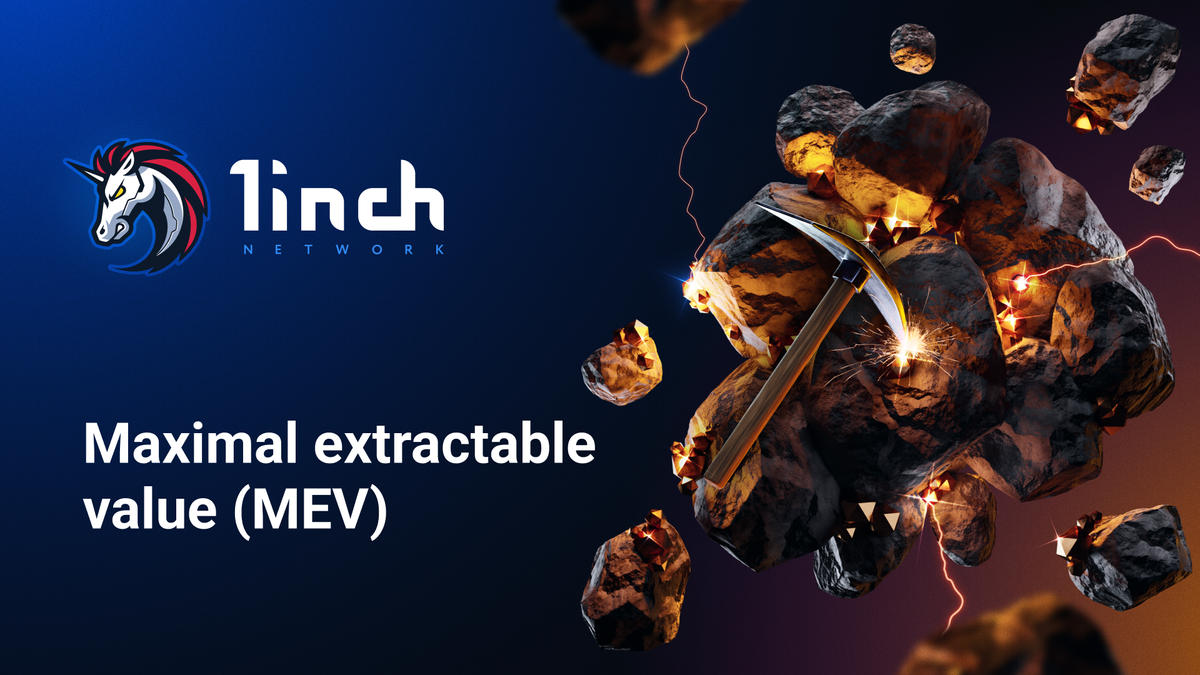
Most swaps look simple - until MEV turns them into a losing trade. Here’s how front-running and sandwich attacks work, and how 1inch protects your swaps from being exploited.
You place a swap. The quote looks good. The price impact seems reasonable. You confirm the transaction - and a few seconds later, the result is worse than expected.
Nothing is “broken.” No error occurred.But value was lost.
This is often the result of MEV - Maximal Extractable Value - and if you’re not actively protecting your swaps, you’re exposed to it.
What actually happens when you swap
When you submit a transaction in DeFi, it doesn’t go directly into a block. It first sits in the mempool - a public queue of pending transactions waiting to be processed.
This is where the problem begins.
The mempool is visible to anyone running a node. That includes specialized bots - known as searchers - whose sole purpose is to scan pending transactions for profit opportunities. Large swaps, in particular, are attractive targets because they can move market prices and create exploitable conditions.
In other words, your transaction becomes predictable, visible, and vulnerable before it is finalized.
How MEV turns into user losses
Not all MEV is harmful. Some of it - like arbitrage or liquidations - helps keep markets efficient. But the type of MEV that affects users directly is toxic MEV, and it usually takes one of the following forms.
Front-running
A bot detects your transaction and submits a similar one with a higher gas fee, ensuring it is executed before yours. This shifts the price against you.
You still complete your swap - but at a worse rate.
Sandwich attacks
This is the most common and damaging form of MEV.
A bot places a trade before your transaction to move the price, then your swap executes at that worse price, and finally the bot exits the position immediately after.
The result is simple: you absorb the price impact, the attacker captures the difference.
In extreme cases, your entire slippage tolerance can be extracted.
Back-running
A transaction is placed immediately after yours to profit from the price movement you created. While less directly harmful, it contributes to congestion and higher gas costs.
Why MEV is becoming more visible
As DeFi grows, so does competition for block space. Searchers continuously monitor the mempool and compete to insert their transactions in profitable positions.
This leads to:
- higher gas bidding
- more aggressive transaction reordering
- increased unpredictability in execution
For users, this translates into worse pricing, higher costs, and less control over outcomes.
In short, the more active the market becomes, the more valuable your transaction becomes to someone else.
The real issue: exposure
The core problem is not that MEV exists. The problem is that your transaction is exposed to it.
If your swap is broadcast openly to the mempool, it can be:
- copied
- reordered
- manipulated
Once that happens, you’re no longer trading in a neutral environment — you’re competing against bots that see your move before it happens.
How to avoid MEV losses
You can’t stop searchers from scanning the mempool. But you can avoid putting your transaction there in a vulnerable form.
This is where execution design matters.
MEV protection with 1inch
1inch addresses this problem at the execution layer.
Instead of exposing your swap to the public mempool, 1inch offers intent-based execution.
Here’s how it changes the game:
Your swap is not broadcast in a vulnerable form
With 1inch, you submit an intent - what you want to swap - rather than a raw transaction that can be exploited. This removes the typical entry point for front-running and sandwich attacks.
Professional resolvers compete to execute your trade
Market makers (resolvers) compete to fulfill your order under predefined conditions. Their incentive is to give you the best possible execution - not to extract value from your transaction.
Execution happens in a controlled environment
Because your trade is not exposed in the same way as a standard mempool transaction, it is shielded from toxic MEV strategies.
This means:
- no front-running
- no sandwich attacks
- no slippage extraction by bots
You get predictable outcomes
Instead of competing with bots for execution priority, you get:
- transparent pricing
- competitive routing across liquidity sources
- consistent results
In other words, your swap behaves the way it should.
Why this matters for DeFi
As on-chain activity grows, MEV is not going away. If anything, it will become more sophisticated.
The question is not whether MEV exists - it’s whether users are protected from it.
If swaps remain exposed to the mempool, user losses will continue to be part of the system. But if execution shifts toward protected models, DeFi can deliver on its promise of fair, efficient markets.
Make a MEV-protected token swap on 1inch now!
Share the article


 Copy done!
Recent Posts
Build trading agents and integrate Web3 APIs in minutes with the 1inch Business MCP
AI agents can now directly access 1inch infrastructure via the 1inch MCP, enabling them to plan and execute swaps, analyze portfolio data and interact with on-chain markets in real time.
How to set limit orders on 1inch
In this post, we’ll explain why you need limit orders and how to make

1inch launches a US DeFi education campaign
1inch is launching 1inch Forward, a US education campaign designed to close that gap. It starts with an open letter to educators and continues with a campus tour across top universities.
