




St. Moritz set the tone. Now Davos must set the direction for crypto

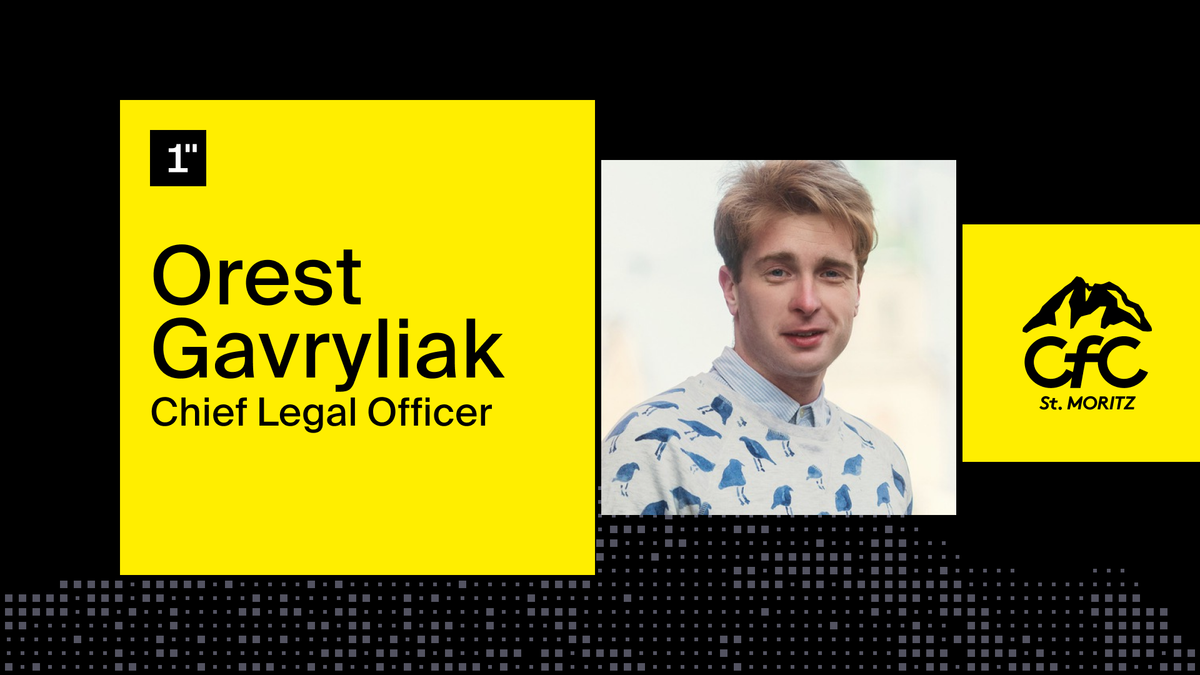
Orest Gavryliak, 1inch Chief Legal Officer, recently attended the CFC St. Moritz Industry Days. In this post, he highlights key themes that emerged there and are likely to resonate at this week’s World Economic Forum Annual Meeting in Davos.
Before the world’s policymakers, CEOs and financiers descend on Davos, crypto has its own proving ground. St. Moritz has emerged as a crucial prelude - a place where the industry stress-tests its ideas before they reach the World Economic Forum Annual Meeting in Davos.
Gatherings like CTC are no longer side events. They’ve become a place where crypto builders and institutions meet, align priorities and shape the conversations that will dominate Davos itself.
The experiment phase is over
For traditional finance institutions, the era of casual experimentation is over. The conversations in St. Moritz made one thing clear: crypto is no longer being treated as a lab project.
Tokenization pilots are moving into production environments. Compliance-by-design is no longer a differentiator - it’s table stakes. And infrastructure is being built with regulations in mind from day one.
That reality is shaping everything from stablecoin rails to custodial segregation models and vendor risk management frameworks. The message from TradFi is clear: innovation is not enough. If crypto wants long-term capital, it must be operationally mature.
Cautious optimism around U.S. clarity
Regulation is still a big question - especially in the U.S. In St. Moritz, many welcomed the direction of the Clarity Act. Clearer definitions and a possible path for brokers feel like real progress after years of uncertainty. For the first time in a while, things are moving.
But the optimism is careful. Few expect an easy ride. Front-end requirements for DeFi are likely to tighten, not loosen. Until the final rules are on paper, U.S. capital will stay on the sidelines.
Even so, the mood is constructive. The industry would rather deal with clear rules - even imperfect ones - than keep operating in the dark.
Regulation isn’t the only issue
One theme stood out above all others: regulation alone will not unlock institutional adoption.
Fragmentation remains a structural obstacle. AI-driven tooling and chain abstraction help simplify complexity, but without a shared-liquidity model, abstraction merely shifts silos rather than removing them. Liquidity trapped by design is still trapped liquidity.
This is where architecture matters. Wallet-based shared liquidity, paired with solver-based execution, closes that gap. Instead of forcing users and institutions to navigate fragmented pools, liquidity becomes accessible where intent is expressed.
From tone to direction
St. Moritz is where the crypto industry now calibrates its message. Davos is where that message must translate into direction. The tone has been set: institutional-grade infrastructure, constructive regulatory engagement and a clear-eyed view of what still blocks adoption.
What is the next step? Alignment - between builders, institutions and policymakers - on how crypto moves forward from here. Davos doesn’t need more noise. It needs decisions.
Stay tuned for more insights from the 1inch team!
Share the article


 Copy done!
Recent Posts
Ondo RWAs on 1inch hit $2.5 bln in volume
Crypto markets may go up and down, but tokenized real-world assets (RWAs) are steadily gaining ground on-chain.

xStocks integrates the 1inch Swap API to improve RWA trading experience
A new partnership between 1inch and xStocks is set to improve on-chain liquidity and elevate the trading experience for tokenized real-world assets (RWA).

1inch in February: focus on security, Alvara integration
February focused on security. In collaboration with our partners, we produced several materials that will help our users stay safe in DeFi. We also launched a partnership with Alvara and attended Web3 Circle Hong Kong and ETHDenver.
