




Fusion mode available on more networks

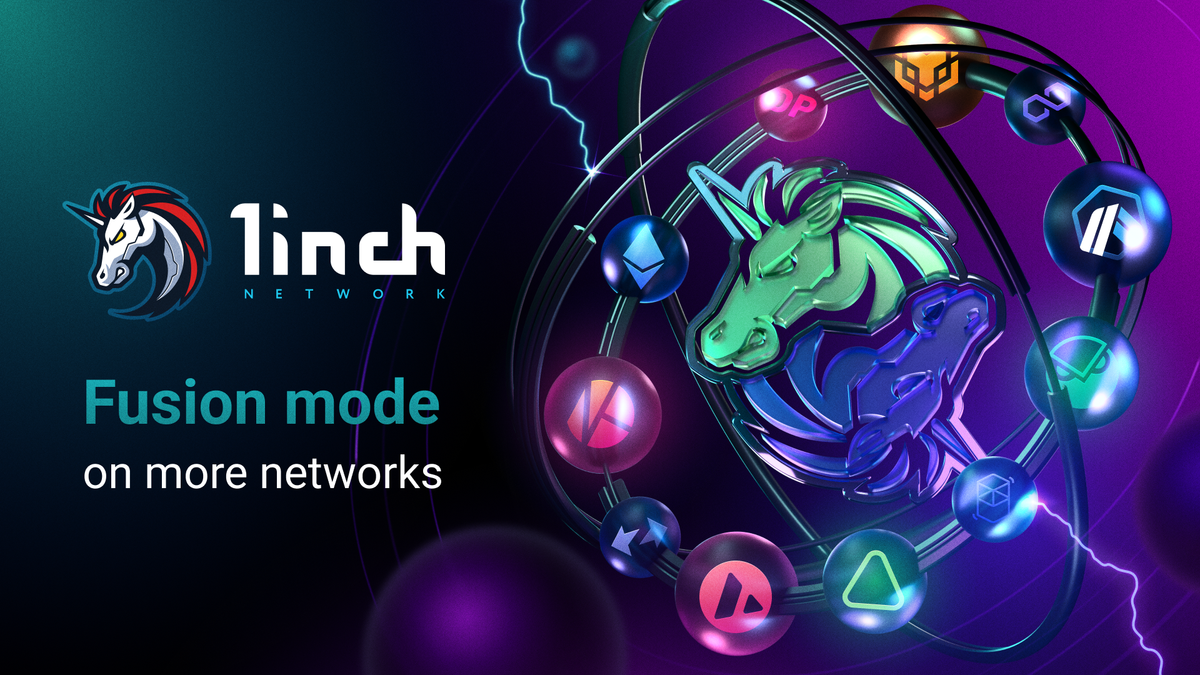
Users of Optimism, Arbitrum, Avalanche, Fantom and Gnosis can now benefit from highly-protected and cost-efficient swaps in the 1inch dApp.
The 1inch Network is thrilled to share that its innovative Fusion mode, which enables users to make protected token swap without paying network fees, is now available on five more networks supported by 1inch.
Launched in December 2022, Fusion mode was originally available on Ethereum, Polygon and BNB Chain.
Since then, over 200,000 swaps with a total value of $5.67 bln have been made on Ethereum with Fusion mode. On Polygon, over 100,000 swaps for a total of $198 mln have been made. BNB Chain saw over 75,000 swaps with a total value of $358 mln.
Now, Optimism, Arbitrum, Avalanche, Fantom and Gnosis have been added.
Powered by the 1inch Swap Engine, Fusion mode enables users to swap tokens on various DEXes without paying any network fees and at the most favorable rates. Any possible issues with liquidity are ruled out, as the 1inch Swap Engine powering Fusion mode is built on top of 1inch’s Aggregation Protocol and Limit Order Protocol, which ensures sufficient liquidity at all times.
In addition, Fusion mode offers users extra protection from maximum extractable value (MEV). All swaps in Fusion mode are executed by resolvers - professional traders, who use the most sophisticated and efficient ways of protecting users’ swaps from MEV.
Stay tuned to learn more about 1inch products and solutions!
Share the article


 Copy done!
Recent Posts

How AI agents execute on-chain trades: from intent to execution
AI agents are turning DeFi trading into a one-step process: define your goal, and let the system handle the rest. Here’s how they move from intent to on-chain execution.
How joint efforts unlocked over $100 mln stuck on Aave
DeFi works best when projects pull together. Several protocols stepped in and built an emergency exit after the recent Aave situation.

AI agents vs trading bots: what’s the difference, and which works better?
AI agents and trading bots automate DeFi trading in different ways. Learn how they compare, where each performs better and why hybrid strategies are emerging as the most effective approach.
