




DeFi Visions: Kosala Hemachandra

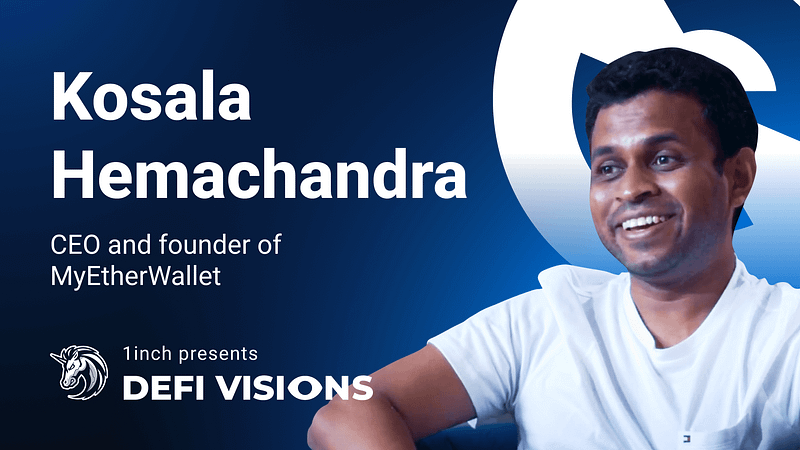
In DeFi Visions, a series of video interviews, the 1inch Network talks to the most prominent people in the DeFi space. This post features the main takeaways from a recent interview with Kosala Hemachandra, founder and CEO of MyEtherWallet (MEW).
Kosala Hemachandra founded MyEtherWallet back in 2015 as an access point to transactions on Ethereum. Now, MEW is the leading and longest running wallet in the Ethereum ecosystem.
According to Kosala, he is happy about Ethereum’s upcoming switch to the proof of stake consensus algorithm from proof of work. “We are gonna reduce energy consumption by 99 percent,” he says. “Before, you had to work for 15 or 16 blocks to make sure that a transaction was valid. Now, it’s two blocks or something.”
“It’s a huge advantage over proof of work, and it can be more diversified, especially with liquid staking and the amount of ETH locked, which is an insane amount,” he adds. “We are going to be the biggest proof-of-stake chain and I think we’re gonna be the only decentralized proof-of-stake chain, as all the other ones are pretty centralized.”
This major change on Ethereum occurs at a time of a bear market, but Kosala sees a silver lining in this situation, as it can help to filter out projects that are not going to be sustainable: “Okay, no one is gonna buy this project, it doesn’t have any value, and when the next rise comes, we’ll go with projects that actually survive that cycle.”
Another advantage of the bear market is that the fall in crypto currencies’ prices makes transactions less expensive.
“If anything, it will reduce the stress of developers,” Kosala comments. “‘Okay, the price went down, I can actually focus on developing now,’ rather than ‘Oh, no, I have to deploy a contract that’s gonna cost $6,000.”
“Sometimes, we spend up to $1,000 or $2,000 a day on mainnet tests to make sure that everything’s working, and it’s very costly,” he explains. “When the price goes down, it reduces our stress a little bit.”
Kosla says that periods when crypto prices are down push projects to focus on developing new solutions rather than on “buying a Lamborghini.”
As someone who arrived in the crypto space years before NFTs and metaverse, Kosala still believes that non-fungible token is “a really good concept,” but NFTs need to have a utility rather than being just jpeg images.
“[Back in 2018], CryptoKitties brought up this pretty cool idea of creating non-fungible tokens out of anything,” he notes. “People ran with [that idea], creating NFTs of jpegs, and most of NFTs are just jpegs.”
But there are questions to be asked about the NFT segment, according to Kosala. “My first question is, ‘Okay, is there anything behind it? How are you bringing value to these jpegs?’”
Metaverse, Kosala observes, has already been there in the centralized world. “Steam, for those who play games, is kind of a metaverse,” he elaborates. “Instead of trying to do the same thing again and again, you should ask the community what the next step is for you.”
Watch the full interview with Kosala Hemachandra on 1inch’s YouTube channel.
Share the article


 Copy done!
Recent Posts

How AI agents execute on-chain trades: from intent to execution
AI agents are turning DeFi trading into a one-step process: define your goal and let the system handle the rest. Here’s how they move from intent to on-chain execution.
Major global companies’ interest in stablecoin payouts to give a boost to the segment
Major global companies’ interest in stablecoin payouts to give a boost to the segment

1inch and KuCoin Web3 Wallet partner to power gasless, MEV-protected swaps for RWA assets
KuCoin Web3 Wallet, a decentralized, non-custodial, multichain wallet built for seamless access to on-chain ecosystems, now integrates the 1inch Swap APIs - bringing smooth, efficient swaps directly into the wallet.
